7 Phrases children need to hear from parents.
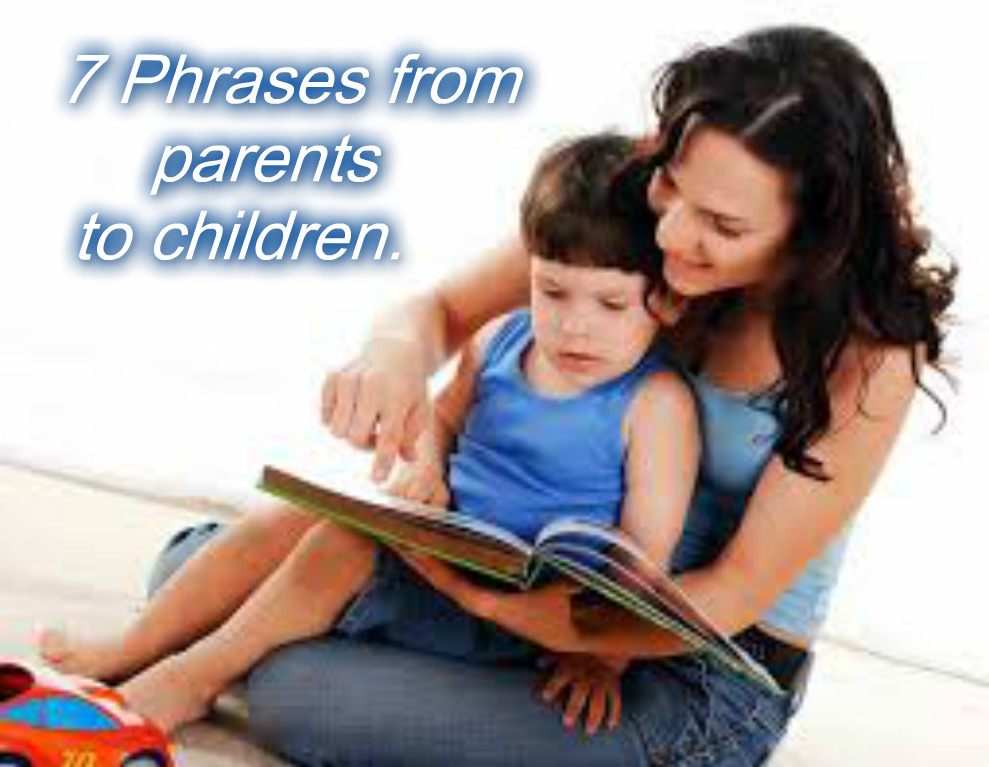
Are you worried that your children aren’t as motivated and hard working as they should be? It’s natural that parents want their children to succeed, and grow as good humans. The parent-child relationship affects the child’s development a lot, both emotionally and mentally. The stronger is the relationship, the better the chances of the child becoming a well-adjusted & successful adult. This article lists seven simple phrases that will help you, as a parent to build that relationship.
The more often you use the phrases, the more likely it is that your child will grow up feeling safe, secure and self-confident. That’s the foundation of long-term success and happiness.
Here are the seven phrases:
1. “I love you”
This is an obvious but vital one. Children need to know that you love and accept them unconditionally. You might feel awkward about saying “I love you” to your children, especially if it isn’t part of your family culture. But get encouraged to say it at least once a month. If you say it once a week or once a day, it’ll be even better.
In a survey with teenagers, 95% of the teenagers confess that they feel as though their parents love them more when they perform well in school or in their other activities. In extreme cases, these children grow up believing that they’ll never be good enough. This can cause them to be unmotivated, or to exhibit other behavioral problems.
The simple solution? Say “I love you” to your children.
2. “Go for it!”
Of course, if your children are about to do something dangerous or unethical, you shouldn’t tell them to “go for it.” You should step in. But when they’re faced with a challenge that they’ll benefit from taking on, they need your encouragement to bolster their confidence. Parents tend to be too cautious, because they take a short-term view of parenting. I’m a parent myself, so I know how tempting this can be.
I believe that the goal of parenting isn’t to shelter our children or to provide them with a comfortable life. It’s to prepare them for adulthood, where they won’t just survive – they’ll thrive.
Adulthood is full of challenges, so in childhood and adolescence your kids need all the practice they can get in overcoming them. To do that, they’ll need your support, and for you to tell them, “Go for it!”
3. “I’m proud of you”
I recommend that you say this to your children frequently, and not just when they’ve achieved something remarkable. Being proud of your children for what they’ve done is different from being proud of them for who they are.
There’s nothing wrong with being proud of your children for what they’ve achieved. But they need to know that you’ll still be proud of them, even if they don’t achieve anything impressive. Whenever you observe your children displaying kindness, generosity, humility, courage, or any other positive behavior, take the opportunity to say, “I’m proud of you.” Don’t underestimate the tremendous power of this simple phrase.
4. “I believe in you”
For many people, childhood and adolescence are times of self-doubt.
• Am I capable enough?
• What will people think of me if I fail?
• Do I have what it takes?
• Why can’t I be as smart as ‘xyz’, or as popular as ‘abc’?
These are the kinds of questions that children ask themselves.
In the midst of their doubt, they need you to be their loyal advocate, their ardent fan. It’s really seems heartbreaking when teenagers pointed out that their parents are their biggest critic, not their biggest fan. Their parents belittle them and put them down. On occasion, their parents even call them “useless” or “stupid.”
I’m blessed that, throughout my own life, my parents have told me that they believe in me – especially when I didn’t believe in myself. This gave me the confidence to dream big and dare to fail.
This is a gift that you can share with your children too, as you say to them, “I believe in you.”
5. “Will you forgive me?”
As a parent, you’re an authority figure in your home. Apologizing to your children is hard, because your pride is at stake. But leaders go first. As a leader in your home, you must take the first step. For example, if you’ve said something unkind during an argument with your child, be the first one to say, “I’m sorry, I shouldn’t have said that. Will you forgive me?”
As you model this kind of humility, your children will develop new respect for you. This is also an excellent opportunity to show your children that we all make mistakes, but that it’s crucial to take responsibility for them.
6. “Will you show me how you did that?”
At some point, your children will know more about certain things than you. Maybe they already know more about social media or music or Internet marketing than you. I know many parents who act as if they know more than their children in every area. When their children bring up almost any topic, these parents cut them off, jump to conclusions, or cast judgment.
Soon enough, these children stop communicating openly with their parents. “Why should I talk to my parents, when they don’t actually listen to what I have to say?” these children think. So if your children know more about something than you, I encourage you to say, “That’s interesting. Tell me more.” If you see your children doing something you’re not able to, why not ask them, “Will you show me how you did that?”
A few days ago, I was waiting to get a haircut when I saw a 14-year-old boy playing with a Rubik’s cube. He solved the Rubik’s cube in less than 15 seconds. I was impressed! The boy’s mother was sitting next to him. She remarked, “Wow! Will you show me how you did that?” Grinning with pride, the boy explained step-by-step how to solve a Rubik’s cube. When you take a genuine interest in your children’s hobbies, they feel valued and respected. This is vital for a healthy parent-child relationship.
7. “I’m here for you”
As children get older, they want more independence. They want the freedom to make choices, and to chart their own course. Parents may start to feel as if their children don’t want to have anything to do with them. But this isn’t the case. Even the most rebellious teenagers I’ve worked with care about what their parents think, at some level.
If your children are in their teens, allow them to make as many of their own choices as possible. After all, they’re going to be adults in a few short years. They’ll appreciate your advice and counsel, as long as you make it clear that the final decision is theirs. Naturally, they must deal with the consequences of their choices too.
By saying “I’m here for you,” your children will know that you’re there to help if the going gets tough. This way, they’ll be more confident as they venture out into the world.
The bottom line:
Parenting is an adventure that’s full of both frustration and joy, but it doesn’t need to be complicated. That’s where these seven simple phrases come in.
Start small. Choose one phrase, and use it at least once in the coming week. The next week, add one more phrase to your list. Soon enough, you’ll be using all seven phrases as a habit. And you’ll be well on your way to bringing up happy and successful children – one day at a time, and one phrase at a time.
Sometimes, as parents, we make parenting too complicated for our own good. Simple but powerful phrases are amazing tools for nurturing a strong relationship with your child! Make your parenting remarkable & interesting…& proud to be PARENTS…
Edlive Intellectuals Forum hopes that as a parent we are able to provide you some beneficial information for you and we wish you good luck!! We will soon be covering some other interesting aspects of parenting in this section…
Always keep smiling … 🙂
Reference: Daniel Wong
Edited by: Team Gyanoday

 Currency Convertor
 Post an article
 15 June, 2015
 Daniel Wong. (Edited by Team Gyanoday).

 sending...